
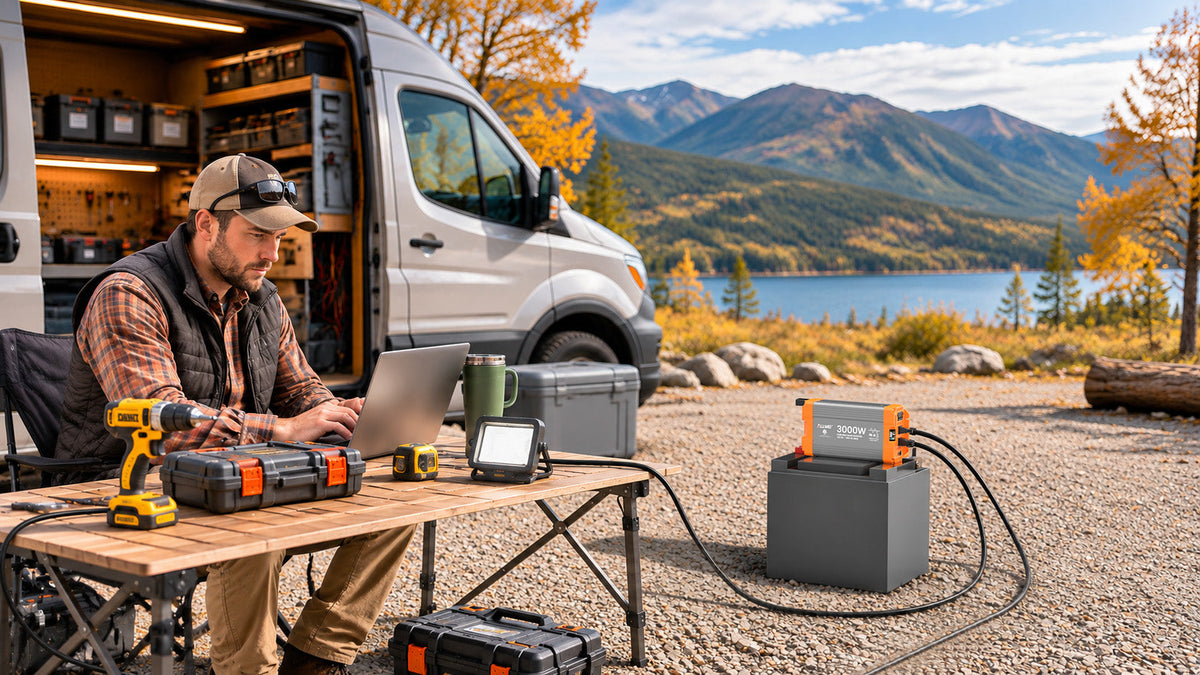
A 3000 watt inverter provides more power capacity than a typical 1000W or 2000W model, making it a practical option for higher-demand RV setups, off-grid systems, workshops, and selected backup power applications.
With 3000W of continuous output, you may be able to operate multiple household appliances at the same time, including kitchen equipment, power tools, refrigerators, and certain air conditioning units.
However, a larger inverter doesn't automatically mean every appliance will work.
You still need to consider the combined running wattage, startup surge requirements, battery discharge capability, and electrical installation.
In this guide, we'll explain what a 3000 watt inverter can run, which appliances may exceed its capabilities, and what kind of battery system is needed to support its full output.
If you're still comparing inverter sizes, start with our What Size Power Inverter Do I Need? 1000W vs 2000W vs 3000W guide.
For RV-specific applications, you can also read What Size Inverter Do I Need for My RV?.

Quick Answer: What Can a 3000 Watt Inverter Run?
A 3000 watt inverter can support multiple AC appliances and selected higher-power equipment, provided their combined running wattage stays within 3000W and their startup requirements are compatible with the inverter.
Common applications may include:
-
Laptops, computers, TVs, and entertainment equipment
-
Coffee makers, microwaves, and selected kitchen appliances
-
Refrigerators and freezers
-
Certain power tools and workshop equipment
-
Selected pumps
-
Some window air conditioners, depending on startup requirements
A 3000W inverter is particularly useful when you need to operate several appliances together rather than relying on a single low-power device.
Here's a general overview:
| Appliance or Equipment | Example Running Power | Important Considerations |
|---|---|---|
| Laptop and monitor | 20-400W | Check combined load |
| LED TV | 50-250W | Depends on screen size |
| Coffee maker | 550-1200W | Check actual input |
| Microwave oven | 1000-2000W | Cooking watts differ from input watts |
| Toaster | 800-1500W | Heating elements consume continuous power |
| Blender | 300-1000W | Motor startup may require extra power |
| Space heater | 1000-1500W | High continuous energy consumption |
| Refrigerator/freezer | Model dependent | Compressor startup surge |
| Window air conditioner | Model dependent | Check running and starting requirements |
| Power tools | Model dependent | Motor startup and operating load |
The wattage examples above are general reference values, not guaranteed compatibility ratings. Eaton's Power Inverter Buying Guide provides a broader appliance wattage reference and recommends checking actual equipment labels.
Always verify your own appliance specifications before connecting it.
Understanding 3000W Continuous Power vs. 6000W Peak Surge
Before deciding what a 3000W inverter can run, it's important to understand the difference between continuous power and peak surge power.
What Does 3000W Continuous Power Mean?
Continuous power is the amount of AC electricity an inverter is designed to provide during normal operation under specified conditions.
A 3000W inverter can supply up to 3000W of continuous output.
For example, consider this hypothetical combination:
| Appliance | Example Running Power |
|---|---|
| Microwave | 1200W |
| Coffee maker | 1000W |
| Television | 150W |
| Laptop | 100W |
| LED lighting | 50W |
| Total | 2500W |
The combined running load is 2500W, which falls below the inverter's 3000W continuous output rating.
This example assumes the appliances' actual input ratings match the figures shown. It does not establish startup compatibility or battery suitability.
What Is Peak Surge Power?
Some appliances require extra power when they start.
This is especially common with:
-
Refrigerators
-
Freezers
-
Air conditioners
-
Water pumps
-
Power tools with motors
-
Air compressors
The ALLWEI P3000-3 specifications list:
| Specification | Value |
|---|---|
| Continuous Output | 3000W |
| Peak Surge Output | 6000W |
| Peak Surge Duration | 0.2 seconds |
| DC Input | 12V |
| AC Output | 120V |
The 6000W peak rating is available for only 0.2 seconds under the manufacturer's specified conditions.
It does not mean the inverter can continuously operate a 6000W appliance.
It also does not guarantee that every motor or compressor can start successfully. Some appliances require elevated startup power for longer than 0.2 seconds.

What Household Appliances Can a 3000 Watt Inverter Run?
A 3000W inverter offers considerable flexibility for household-style AC appliances, especially when you manage which devices operate simultaneously.
Kitchen Appliances
Kitchen appliances are among the most common higher-power loads.
A properly matched 3000W inverter may support equipment such as:
-
Coffee makers
-
Microwaves
-
Toasters
-
Blenders
-
Selected countertop cooking appliances
For example, imagine using a 1000W coffee maker and a microwave with a verified 1200W electrical input.
Their combined running demand would be:
1000W + 1200W = 2200W
That is within a 3000W continuous output rating, assuming no other significant loads are running.
However, if you add another high-power appliance, the total can quickly approach the inverter's limit.
Also remember that the advertised cooking power of a microwave may differ from its actual electrical input power.
Always check the appliance nameplate.
Refrigerators and Freezers
A 3000W inverter may be suitable for many refrigerators and freezers, but compressor startup requirements still need to be checked.
A refrigerator's normal running wattage can be considerably lower than its startup demand.
For example, Generac's appliance sizing reference lists one refrigerator/freezer example at 700W running power with an additional 2200W of starting power.
This is an illustrative reference, not a specification for every refrigerator.
For the ALLWEI P3000-3, the 6000W surge rating is specified for only 0.2 seconds. You must verify that the actual compressor startup demand and duration are compatible.
Electric Heaters and Heating Appliances
Some electric heaters can operate within a 3000W inverter's continuous output rating.
For example, a 1500W space heater would use half of the inverter's rated continuous capacity when operating by itself.
However, heating appliances can consume a substantial amount of battery energy over time.
A larger inverter does not automatically mean longer operating time.
If you plan to use an electric heater for extended periods, pay particular attention to battery capacity and charging availability.
Can a 3000 Watt Inverter Run an Air Conditioner?
A 3000W inverter may run certain window air conditioners, but compatibility depends on the specific unit's running power, compressor startup requirements, and surge duration.
Air conditioners are among the more demanding appliances because compressors can require additional power when starting.
For example, Generac's appliance sizing reference lists a 10,000 BTU window AC at approximately:
-
Running power: 1200W
-
Additional starting power: 1800W
That illustrates why checking both running and starting requirements matters.
A 3000W inverter may have sufficient continuous capacity for some window AC units, but the startup requirement must also be checked.
The ALLWEI P3000-3 provides 6000W peak surge for 0.2 seconds. If an air conditioner requires additional power for longer than this specified period, successful startup cannot be assumed.
Also distinguish between:
-
Small window air conditioners
-
Portable air conditioners
-
RV rooftop air conditioners
-
Central air conditioning systems
Their electrical requirements can differ significantly.
A large central air conditioner may exceed 3000W even during normal operation.
Do not choose an inverter based only on an air conditioner's BTU rating.
Check its electrical nameplate and manufacturer specifications, including starting current or locked-rotor information where available.
Can a 3000 Watt Inverter Run Power Tools?
For workshop users, contractors, mobile mechanics, and DIY enthusiasts, a 3000W inverter can provide useful AC power for selected tools.
Potential applications include:
-
Electric drills
-
Circular saws
-
Jigsaws
-
Sanders
-
Shop vacuums
-
Selected air compressors
For example, Eaton's appliance reference lists an electric drill at approximately 700W and a circular saw at approximately 1250W.
These examples illustrate how different tools can have very different electrical demands.
A 3000W inverter may support one higher-power tool or several smaller tools, depending on their combined running wattage and startup requirements.
However, motor-driven equipment can draw additional power when starting or under heavy working loads.
A circular saw cutting through dense material, for example, may require more power than it uses under lighter operating conditions.
If you're planning a mobile workshop or work truck system, make a list of the tools you expect to use simultaneously rather than sizing the inverter according to the largest tool alone.
What Can a 3000 Watt Inverter Not Run?
A 3000W inverter provides substantial power, but it still has limits.
Some appliances and electrical systems may require more continuous output than the inverter can supply.
Large Central Air Conditioning Systems
Some central AC systems exceed 3000W during normal operation, before startup requirements are considered.
A larger inverter does not automatically make a central air conditioning system compatible. The complete electrical requirements must be evaluated.
Electric Clothes Dryers
Electric clothes dryers are high-power appliances.
Generac's appliance reference lists an example electric clothes dryer at approximately 5400W running power.
That is well beyond the continuous output rating of a 3000W inverter.
Large Electric Water Heaters
An electric water heater may also exceed the inverter's output capacity.
For example, Generac lists a typical electric water heater reference value of 4000W.
This is another example of why a larger appliance does not necessarily become compatible just because the inverter has a high peak surge rating.
Multiple High-Power Appliances Together
Even if each appliance works individually, their combined load may exceed 3000W.
For example:
-
Coffee maker: 1000W
-
Microwave: 1500W
-
Space heater: 1500W
Combined running load:
1000W + 1500W + 1500W = 4000W
This exceeds the inverter's continuous output rating.
The solution is to reduce simultaneous loads or select a power system designed for the actual demand.
What Size Battery Do You Need for a 3000 Watt Inverter?
This is one of the most important considerations when choosing a 3000W inverter.
The ALLWEI P3000-3 uses a compatible 12V battery system.
At full output, a 3000W inverter requires substantial DC current from the battery.
How Much Current Does a 3000W Inverter Draw?
A simplified calculation is:
DC Input Current ≈ AC Output Power ÷ (Battery Voltage × Inverter Efficiency)
For an illustrative calculation, assume:
-
AC output: 3000W
-
Battery voltage: 12.8V
-
Conversion efficiency: 86%
Estimated current:
3000W ÷ (12.8V × 0.86) ≈ 273A
This means a 3000W AC load can require approximately 273A from a 12.8V battery under these assumptions.
Actual current changes with battery voltage, load, and conversion efficiency.
This is a major reason why a 3000W 12V inverter needs a carefully designed battery system.
Why Battery Discharge Capability Matters
Battery capacity is commonly measured in amp-hours (Ah), but capacity alone does not determine whether a battery can operate a 3000W inverter.
You must also check:
-
Maximum continuous discharge current
-
Battery management system (BMS) current limits
-
Battery voltage under heavy load
-
Number of batteries and their configuration
-
Cable and protection requirements
For example, a 300Ah battery may contain substantial stored energy, but that does not automatically mean it can safely deliver approximately 273A continuously.
The battery manufacturer's discharge specifications must support the intended load.
Important Installation Requirements for the ALLWEI 3000W Model
The ALLWEI P3000-3 manual specifies a 300A DC circuit breaker recommendation for its 12V system.
It also recommends 1/0 AWG cable for a standard installation, while emphasizing that actual cable selection depends on the distance between the battery and inverter and the specific load conditions.
The 3000W model does not include battery connection cables.
These specifications should not be treated as a universal installation prescription. Cable sizing, overcurrent protection, grounding, and installation must comply with applicable electrical requirements, including the NEC, and be handled by a qualified professional.
How Long Can a Battery Run a 3000W Inverter?
The inverter's 3000W rating describes its maximum continuous output capability, not how long it can operate.
Runtime depends on the battery's usable energy and the actual connected load.
Let's use an illustrative battery system:
-
Battery voltage: 12.8V
-
Battery capacity: 300Ah
-
Nominal battery energy: 3840Wh
-
Assumed usable capacity: 80%
-
Assumed inverter efficiency: 86%
Usable AC energy estimate:
3840Wh × 0.80 × 0.86 = 2642Wh
If the actual connected load is 1000W:
2642Wh ÷ 1000W ≈ 2.6 hours
If the actual load is 3000W:
2642Wh ÷ 3000W ≈ 0.9 hours
These are illustrative energy calculations, not measured ALLWEI runtime results.
Real operating time depends on battery chemistry, temperature, battery condition, actual efficiency, load fluctuations, and discharge limitations.
Also, the battery must be capable of delivering the required current. Having enough stored energy does not automatically mean the battery can support a full 3000W load.

Why Choose a Pure Sine Wave 3000W Inverter?
A pure sine wave inverter produces AC electricity with a smooth waveform designed to support a broad range of household electronics and electrical equipment.
This is particularly relevant for equipment containing motors, compressors, and sensitive electronic components.
The ALLWEI P3000-3 offers:
-
3000W continuous output
-
6000W peak surge for 0.2 seconds
-
12V DC battery input
-
120V AC output
-
Pure sine wave output
-
LCD display
-
Temperature- and load-controlled cooling fans
-
Multiple electrical protection functions
The manufacturer also specifies total harmonic distortion (THD) of 5% or less under its stated full-load measurement conditions.
Pure sine wave output does not guarantee compatibility with every appliance. Always verify the equipment's voltage, frequency, running power, and startup requirements.
Is the ALLWEI 3000W Pure Sine Wave Inverter Right for You?
If your electrical requirements exceed what a 1000W or 2000W inverter can comfortably support, the ALLWEI P3000-3 may be worth considering.
It is designed for users who need higher continuous AC output in applications such as:
-
RV and camper electrical systems
-
Off-grid cabins
-
Mobile workshops and work trucks
-
Selected backup power applications
-
Systems using higher-power AC appliances
One important consideration is that this is a standalone DC-to-AC inverter.
It does not contain a battery, provide built-in battery charging, or function as a hybrid solar inverter.
If you plan to use solar panels, you will need a separate compatible charging system.
You can review the ALLWEI 3000 Watt Pure Sine Wave Inverter - 12V DC to 120V AC Converter for its full product specifications and availability.
Final Verdict: What Can a 3000 Watt Inverter Run?
A 3000 watt inverter can support a wide range of higher-power AC applications, from kitchen appliances and power tools to selected refrigerators, pumps, and air conditioning units.
It is particularly useful when you need more continuous output or want to operate multiple appliances simultaneously.
However, its actual capability depends on more than the 3000W rating.
Before purchasing, check:
-
The combined running wattage of your appliances.
-
The startup surge requirements and duration of motor-driven equipment.
-
Whether your 12V battery system can supply the required DC current.
-
Whether the cables and protection devices are suitable for the installation.
-
Whether the inverter's AC connections are appropriate for your intended loads.
A 3000W inverter can offer greater flexibility, but the battery and electrical installation must be designed to support it.
The best power system is one where the inverter, battery, appliances, and installation all work together.
Frequently Asked Questions
Can a 3000 watt inverter run a microwave?
Yes, a 3000W inverter may run many microwaves, provided the microwave's actual electrical input is within the inverter's continuous output rating and the battery can supply the required power. Remember that cooking wattage and electrical input wattage are not always the same.
Can a 3000 watt inverter run a refrigerator and freezer at the same time?
It may be possible, but you need to add their combined running wattage and account for compressor startup requirements. If both compressors start at the same time, their combined surge demand may exceed the inverter's available short-duration power.
Can a 3000 watt inverter run an air conditioner?
Some window air conditioners may be compatible with a 3000W inverter. However, startup current and surge duration must be checked. Do not assume every window, portable, or RV air conditioner will work.
Can a 3000 watt inverter run a whole house?
A standalone 3000W inverter is generally intended for selected loads rather than automatically powering an entire house. Household circuits require appropriately designed transfer and isolation equipment, compliant installation, and professional electrical work. Never backfeed household wiring through a standard outlet.
What size battery do I need for a 3000 watt inverter?
There is no single battery capacity suitable for every installation. You must consider usable energy, continuous discharge current, BMS limits, voltage, and desired runtime. A 12V battery system supporting a full 3000W AC load may need to deliver approximately 270A under illustrative operating assumptions.
Does the ALLWEI 3000W inverter include battery cables?
No. The ALLWEI P3000-3 does not include battery connection cables. The correct cable and protective-device specifications must be determined according to the installation conditions and applicable electrical requirements.
Is a 3000W inverter better than a 2000W inverter?
Not necessarily. A 3000W inverter provides more continuous output capacity, but it also requires a battery system capable of supplying more current. If your actual load stays comfortably within 2000W, a 2000W inverter may be a more appropriate choice.


Leave a comment
This site is protected by hCaptcha and the hCaptcha Privacy Policy and Terms of Service apply.