
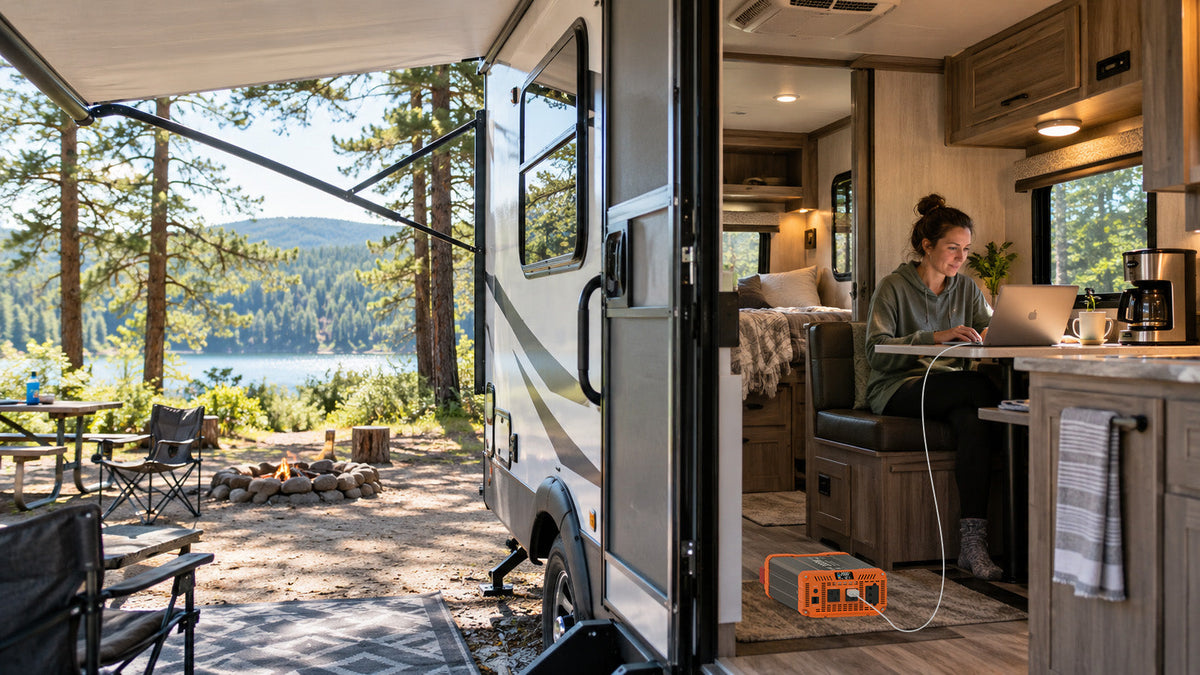
A 2000 watt inverter is a popular choice for RV owners, camper van users, and off-grid enthusiasts because it provides a balance between power capacity and system size.
Compared with smaller inverter sizes, a 2000W inverter can support more demanding AC appliances while still remaining practical for many mobile and off-grid applications.
However, choosing an inverter is not only about the wattage number.
The actual devices you can run depend on:
- The appliance's running wattage
- Startup surge requirements
- Your battery system's capacity and discharge capability
- The total number of devices operating at the same time
This guide explains what a 2000 watt inverter can typically run, what appliances require extra attention, and how to determine whether a 2000W system is suitable for your needs.

Quick Answer: What Can a 2000 Watt Inverter Run?
A 2000 watt inverter can power many common electronics, appliances, and tools as long as the combined power demand stays within its continuous output rating and startup requirements are compatible.
Typical applications may include:
| Device | Typical Power Range | Important Considerations |
|---|---|---|
| Laptop | 50-100W | Usually a low-power load |
| TV | 50-200W | Depends on screen size and model |
| LED lighting | 5-50W | Low energy consumption |
| Wi-Fi router | 10-30W | Suitable for backup use |
| Coffee maker | 800-1500W | Check actual input wattage |
| Microwave | 800-1500W | Startup and input power matter |
| Small refrigerator | 100-300W running | Compressor startup requires checking |
| Small power tools | 500-1500W | Motor startup may require additional capacity |
These values are general examples only.
Always check the actual specifications of your equipment before selecting an inverter.
A device's advertised rating may not represent its real electrical demand.
For example, a microwave's cooking power is not always the same as its electrical input power.

Understanding 2000W Continuous Power vs Surge Power
One of the most common mistakes when choosing an inverter is confusing continuous power and surge power.
Continuous Power
Continuous power refers to the amount of AC power an inverter can provide during normal operation.
A 2000W inverter is designed to provide:
2000 watts of continuous output
under appropriate operating conditions.

Surge Power
Some appliances require additional power when starting.
This is common with devices that contain:
- Motors
- Compressors
- Pumps
Examples include:
- Refrigerators
- Freezers
- Certain power tools
- Some air conditioning systems
The ALLWEI P2000-3 pure sine wave inverter specifications include:
| Model | Continuous Output | Peak Surge Output | Surge Duration |
|---|---|---|---|
| P2000-3 | 2000W | 4000W | 0.2 seconds |
The surge rating provides short-term additional power capability.
It does not mean a 2000W inverter can continuously operate a 4000W load.
An appliance that requires high startup power for longer than the inverter's surge capability may still cause overload protection.
What Can a 2000 Watt Inverter Run in an RV?
RV users are one of the most common groups choosing 2000W inverters.
A properly matched 2000W inverter can support many everyday RV power needs, including:
- Laptops
- TVs
- Lighting
- Small kitchen appliances
- Charging electronics
- Selected household-style appliances
A typical RV setup may look like this:
| Device | Example Power |
|---|---|
| Laptop charger | 70W |
| TV | 100W |
| LED lights | 30W |
| Router | 20W |
| Total | 220W |
This type of load is relatively small compared with a 2000W inverter's continuous output capability.
The challenge usually comes from higher-power appliances.
For example:
- Coffee makers
- Microwaves
- Refrigerators
- Power tools
These devices require more careful evaluation.
The ALLWEI P2000-3 is designed for 12V battery systems and converts battery DC power into 120V AC output. The manual lists applications including RVs, vans, boats, and off-grid locations.
Can a 2000 Watt Inverter Run a Microwave?
A 2000W inverter may run some microwaves, but compatibility depends on the microwave's actual electrical input requirements.
One common mistake is looking only at the microwave's cooking power.
For example:
A microwave advertised as:
1000W cooking power
may require more than 1000W from the AC outlet.
Before using a microwave with a 2000W inverter:
- Check the microwave's input wattage.
- Check whether other appliances will run at the same time.
- Confirm that the battery system can provide enough current.
A microwave may work individually but overload the system when combined with another high-power appliance.
Can a 2000 Watt Inverter Run a Refrigerator?
A refrigerator requires additional consideration because it uses a compressor.
Unlike simple electronics, refrigerators usually have:
- Lower running power
- Higher startup demand
A refrigerator that normally consumes only a few hundred watts may require significantly more power when the compressor starts.
Whether a 2000W inverter can run a refrigerator depends on:
- Refrigerator specifications
- Startup surge requirement
- Battery capability
- Inverter performance
A pure sine wave inverter can be beneficial for appliances with motors because it provides a smoother AC waveform, but compatibility still depends on the actual electrical requirements of the appliance.
What Can a 2000 Watt Inverter Not Run?
A 2000W inverter is powerful, but it is not designed for unlimited loads.
Some applications may exceed its practical capability.
Large Air Conditioners
Air conditioners often have high startup requirements.
A specific AC unit may or may not work depending on:
- Compressor size
- Starting current
- Continuous power demand
- Battery system
Always check the equipment specifications first.
Electric Heating Appliances
Electric heaters consume significant continuous power.
Examples:
- Space heaters
- Electric ovens
- High-power heating devices
Even if an appliance is within the inverter's wattage rating, it may drain the battery very quickly.
Multiple High-Power Appliances at Once
A common mistake is adding devices individually without checking the total combined load.
Example:
Coffee maker:
1000W
Microwave:
1200W
=
2200W
The combined load exceeds a 2000W inverter before considering startup power.
What Size Battery Does a 2000 Watt Inverter Need?
A 2000W inverter does not contain energy itself.
The battery provides the stored energy and must also supply enough current.
ALLWEI P2000-3 uses a 12V battery system.
At higher power levels, a 12V inverter requires significant DC current.
For example:
A 2000W AC load from a 12V battery system may require well over 150A of DC current depending on voltage and efficiency.
The exact requirement depends on:
- Battery voltage
- Inverter efficiency
- Actual load
- Battery discharge capability
A battery with a large capacity rating does not automatically mean it can support a high-power inverter.
You should also consider:
- Maximum continuous discharge current
- Battery management system limits
- Cable sizing
-
Protection devices

How Long Can a Battery Run a 2000W Inverter?
Runtime depends on the battery capacity and actual power consumption.
The basic relationship is:
Battery Energy (Wh) = Voltage (V) × Capacity (Ah)
Example:
A 12.8V 200Ah battery:
12.8V × 200Ah = 2560Wh
Assuming:
- 80% usable capacity
- 85% inverter efficiency
- 500W actual load
Estimated runtime:
2560Wh × 0.8 × 0.85 ÷ 500W ≈ 3.5 hours
This is an example calculation only.
Actual runtime varies depending on:
- Battery chemistry
- Temperature
- Battery age
- Actual appliance cycling
- Inverter efficiency
Why Choose a Pure Sine Wave 2000W Inverter?
A pure sine wave inverter produces AC electricity with a waveform similar to utility power.
This can be beneficial for:
- Sensitive electronics
- Computers
- Audio equipment
- Appliances with motors
The ALLWEI P2000-3 provides:
- 2000W continuous output
- 4000W peak surge capability
- 12V DC input
- 120V AC output
The inverter also includes protection features such as:
- Over-voltage protection
- Under-voltage protection
- Overload protection
- Short circuit protection
- Over-temperature protection
Learn more about the:
ALLWEI 2000W Pure Sine Wave Inverter
Common Mistakes When Choosing a 2000W Inverter
1. Choosing Based Only on Peak Power
Peak power is temporary.
Always prioritize continuous output capability.
2. Ignoring Battery Capability
A powerful inverter requires a battery system that can provide sufficient current.
3. Running Too Many Appliances Together
Always calculate your maximum simultaneous load.
4. Confusing an Inverter With a Portable Power Station
A standalone inverter does not include:
- Built-in battery
- Solar charging
- Automatic backup switching
It requires a separate battery system.
Final Verdict: Is a 2000 Watt Inverter Right for You?
A 2000 watt inverter is a versatile choice for users who need more power than basic electronics but do not necessarily need a larger 3000W system.
It is commonly considered for:
- RVs
- Camper vans
- Camping setups
- Off-grid applications
- Backup power systems
Before purchasing, check:
- Your total running wattage
- Startup requirements
- Battery discharge capability
- Installation requirements
A correctly sized inverter will provide better performance than simply choosing the highest wattage available.
If your calculations show that a 2000W system matches your needs, explore the:
ALLWEI 2000W Pure Sine Wave Inverter
Frequently Asked Questions
Can a 2000 watt inverter run a refrigerator?
A 2000 watt inverter may run some refrigerators, but compatibility depends on the refrigerator's running power, startup surge requirements, battery system, and inverter specifications.
Can a 2000 watt inverter run a microwave?
Some microwaves may work with a 2000W inverter, but always check the appliance's electrical input rating rather than only the cooking power.
Is a 2000 watt inverter enough for an RV?
For many RV users, a 2000W inverter provides a good balance between power capacity and system size. The correct choice depends on the RV appliances and battery system.
What battery size do I need for a 2000 watt inverter?
There is no single battery size that works for every situation. Battery capacity, discharge capability, desired runtime, and load requirements all affect the correct choice.
Can a 2000 watt inverter run an air conditioner?
Some smaller air conditioners may work, but compatibility depends on startup current, continuous power demand, and battery capability.
Does a 2000 watt inverter need a large battery?
A larger battery provides more stored energy, but discharge capability is equally important. A battery must be able to safely provide the current required by the inverter.



Leave a comment
This site is protected by hCaptcha and the hCaptcha Privacy Policy and Terms of Service apply.